During a recent visit to Beijing, former U.S. President Donald Trump reportedly characterized a proposed $14 billion arms sale to Taiwan as a “very good negotiating chip” during discussions with Chinese President Xi Jinping. This statement, which emerged after three days of high-level talks, has sparked debate over the nature of American security commitments to Taiwan and their role in the broader U.S.-China relationship. The comment reframes what has traditionally been viewed as a strategic guarantee for a democratic ally into a bargaining tool—a shift that raises questions about the future of cross-strait dynamics and great-power diplomacy.
Background: The Taiwan Arms Deal and Trump’s Meeting with Xi
The arms package, valued at $14 billion, includes advanced military equipment such as fighter jets, missiles, and naval systems. Taiwan, which the United States does not formally recognize as a sovereign state but maintains unofficial ties with under the One-China policy, has long relied on American weaponry to bolster its self-defense capabilities against potential aggression from mainland China. The proposed sale was initially approved by the Trump administration as part of its commitment to support Taiwan’s defense. However, Trump’s remarks to Xi during their Beijing summit—as reported by Fox News—suggested that the deal could be leveraged in negotiations on other issues, such as trade or regional security.
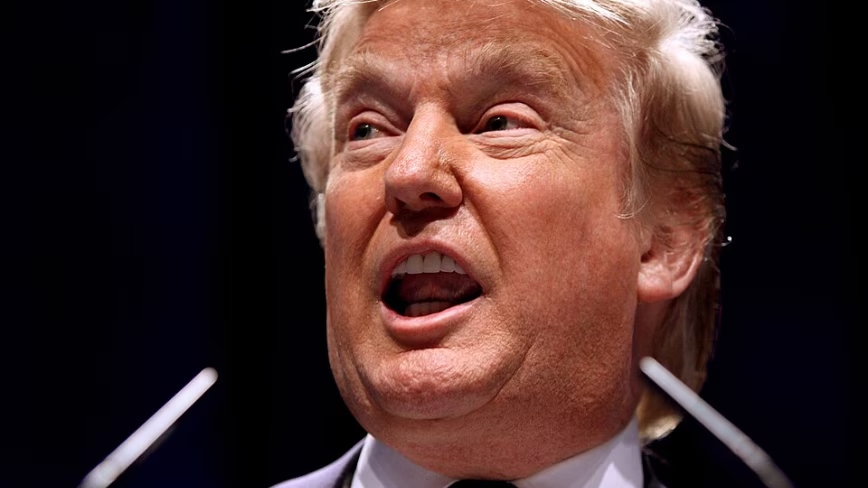
The $14 Billion Package
The specific contents of the arms package include upgrades to Taiwan’s existing defense systems, new submarines, and advanced radar technology. Proponents argue these systems are essential for maintaining a balance of power in the Taiwan Strait, while critics warn they risk provoking Beijing. The deal had been in the works for months, but Trump’s framing of it as a “negotiating chip” marked a departure from previous administrations’ approaches, which consistently emphasized the moral and strategic importance of supporting Taiwan’s defense.
Trump’s Statement: A Bargaining Token?
Trump’s characterization of the arms sale as a “negotiating chip” was not a direct quote from official transcripts but rather an account from sources familiar with the private conversation. The phrase suggests that the transaction is not an irrevocable commitment but rather a flexible instrument that could be traded away for concessions from China. This aligns with Trump’s transactional approach to foreign policy, where deals and alliances are often viewed through the lens of short-term gain rather than long-term principles. The comment has been interpreted by some analysts as a signal that the United States may be willing to sacrifice Taiwan’s security in exchange for Chinese cooperation on issues like trade imbalances or North Korea.
Reaction from Taiwan and Allies
In Taipei, the reaction was cautious but concerned. Taiwanese officials emphasized that the island’s defense is not a matter for negotiation, but they stopped short of directly criticizing Trump. Allies such as Japan and Australia, who closely monitor U.S. commitments in the region, privately expressed unease. The statement could undermine trust in American security guarantees, which are central to the stability of the Indo-Pacific region. Opposition figures in Taiwan accused the U.S. of treating the island as a pawn in its rivalry with China.

Analysis: Shifting U.S. Policy or Diplomatic Posture?
The remark—whether casual or calculated—raises fundamental questions about U.S. policy toward Taiwan. Historically, the United States has adhered to the One-China policy while maintaining the right to sell defensive arms to Taiwan under the Taiwan Relations Act. This dual approach has been a delicate balancing act. Trump’s “negotiating chip” rhetoric, however, blurs that balance by implying that the arms deal is contingent upon broader negotiations. It is unclear whether this represents a deliberate shift in policy or simply an offhand comment designed to project toughness in bilateral talks.
Implications for Great-Power Relations
Experts argue that the statement could complicate future arms sales and the U.S. stance on Taiwan. If China perceives that the arms package is negotiable, it may push harder for concessions on other fronts, such as trade or technology. Conversely, Taiwan’s government may question the reliability of U.S. support, potentially driving it closer to other partners or accelerating its own defense production. On a broader scale, the incident underscores the transactional nature of Trump-era diplomacy, where even long-standing alliances can be reframed as bargaining chips in a zero-sum game.
Conclusion
Trump’s comment about the Taiwan arms deal, made during his three-day visit to Beijing, highlights the intersection of military sales, great-power competition, and diplomatic leverage. While the $14 billion package remains a significant commitment on paper, its portrayal as a “negotiating chip” injects uncertainty into the U.S.-Taiwan relationship. As the situation evolves, all parties must consider the long-term consequences of treating security guarantees as mere bargaining tools. For now, the statement serves as a reminder that in the complex arena of international politics, even firmly stated commitments can be reframed to serve broader strategic ends.
Back to Background | Back to Trump’s Statement | Back to Analysis